 Motors Trak™
How To Keep Track Of Car Maintenance Without Losing Receipts
Most people know their car needs oil changes, tire rotations and new brakes now and then. The hard part is remembering what was done, when, and at what mileage. A shop sticker on the windshield helps for one job. It does nothing for the cabin air filter you changed yourself, the battery the parts store installed, or the transmission service the last owner may or may not have done.
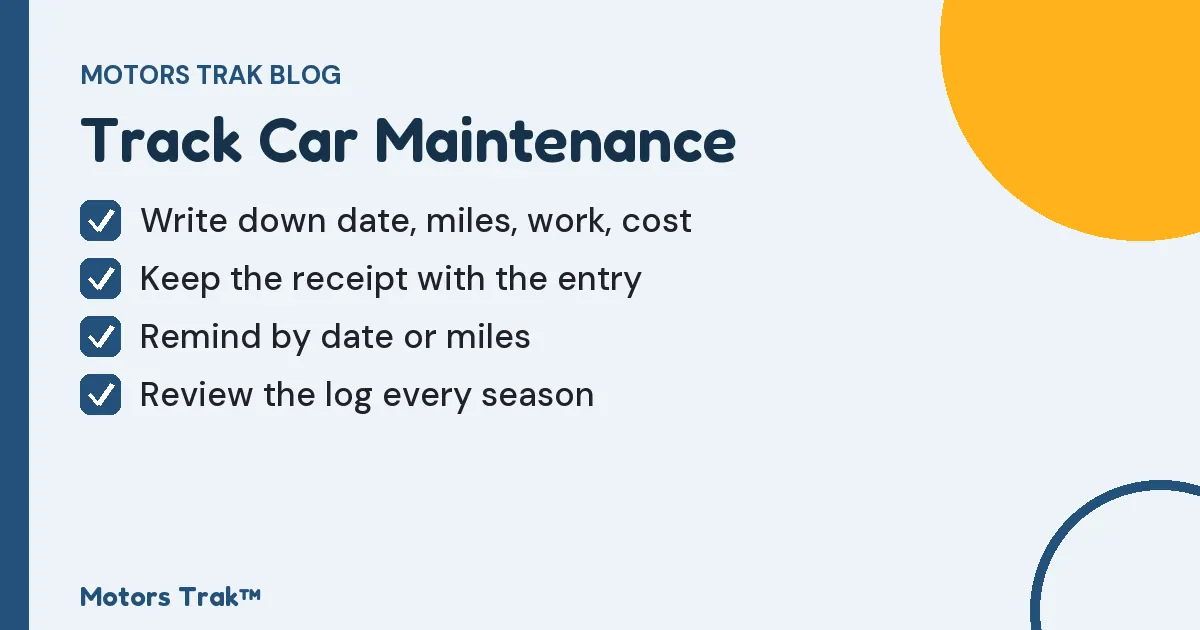
Keeping track of car maintenance comes down to three things. Record every job the same way. Keep the proof next to the record. Set a reminder for the next one before you forget. This guide walks through each part and shows a system that holds up for the life of the car.
Why a maintenance record matters
A good record answers four questions fast. What is due next? What was done last time? What did it cost? Where is the paperwork?
Those answers pay off in a few ways.
- Warranty claims. The Federal Trade Commission explains that you can have routine maintenance done by an independent shop or do it yourself without voiding a new car warranty. If a claim is ever questioned, your receipts and log are how you show the work was done on time.
- Selling the car. Buyers trust a car with a paper trail. We cover this in do service records help when you sell your car.
- Fewer surprises. When you can see that the coolant is original at 95,000 miles, you can plan for it instead of finding out on the highway.
- Fewer duplicate jobs. Without a record, it is easy to pay for a fuel system cleaning twice in one year.
What to write down for every job
Use the same fields every time. Consistency is what makes a log searchable years later.
- Date of the service.
- Odometer reading at the time of service.
- What was done, in plain words. "Oil and filter, 0W-20 full synthetic, 4.4 quarts" beats "oil change."
- Parts and fluids, with brand and part number when you have them.
- Who did it: the shop name, or "me."
- Cost, including parts and labor if the invoice splits them.
- Notes, such as "front pads at 4 mm, rears fine" or "shop says rear shocks leaking."
The notes field gets skipped most often, and it is often the most useful. A mechanic's comment about a slow leak is the early warning for next year's repair.
Where to keep the receipts
Paper receipts fade, and a glovebox full of them is hard to search. Pick one home for the proof and stick to it.
- A folder or envelope in the house, sorted by date. It works, but it lives in one place and can be lost in a move.
- Photos or scans on your phone. Take a picture of the invoice before you leave the shop. Name it or attach it to the matching log entry.
- Both. Keep the paper for big jobs like a timing belt or transmission, and keep a photo of everything.
The rule that matters is this. Each receipt should be easy to find from its log entry, and each log entry should point to its receipt.
Steps
- Find your maintenance schedule. Look in the owner's manual or the manufacturer's owner website. Note whether your car has a normal and a severe service schedule. AAA advises following the time and mileage guidelines in your manual, and the stricter schedule if you drive in severe conditions.
- Write down the car's identity. Record the year, make, model, engine and VIN. The VIN is on the driver's side dashboard near the windshield and on the door jamb sticker.
- Rebuild the past. Gather any old receipts and the last owner's records. Enter them in date order. Even a partial history beats none.
- Log the current odometer reading. This is the starting point for every mileage reminder.
- Set reminders for the next jobs. For each item, set both a date and a mileage. Most manuals list intervals as months or miles, whichever comes first.
- Log each job the day it happens. Enter it in the parking lot while the invoice is in your hand.
- Check for recalls. Enter your VIN at NHTSA's recall lookup a few times a year. Open recalls are repaired free at a dealer.
- Review once a season. Look at what is coming due and what you skipped. Adjust reminders if your driving changed.
Paper notebook, spreadsheet or app
Any of the three can work. The best one is the one you will keep using.
A paper log book is cheap and needs no battery. It cannot remind you of anything, and it is easy to leave in the wrong car.
A spreadsheet is free and flexible. It also starts empty, has no reminders unless you build them, and is awkward to update from a parking lot.
A maintenance app puts the log, the receipts and the reminders in one place on the phone you already carry. This is the problem Motors Trak was built to handle. You can scan the VIN with the camera to fill in the year, make and model. Each oil change, repair and part goes into a service log. Reminders can fire by date or miles, whichever comes first. Receipts and photos stay with the record on your phone. When you want the whole history on paper, you can export a service history PDF or CSV. You can see the full list on the features page.
Keep it going for years
The system only works if you keep feeding it. A few habits help.
- Log before you drive away. If you wait until you get home, you will forget the mileage.
- Back up the record. A phone can break or get lost. Export or back up your log to a file you keep somewhere safe, such as iCloud Drive or a computer.
- Track every engine in the household. Mowers, boats and motorcycles need the same care. Our guides on storing a lawn mower for winter and changing oil by time or mileage show how the same habits apply.
- Keep old records when you sell. Hand the history to the next owner. It helps them, and it helps you sell.
Missing older records? Our guide on how to get maintenance records for your car shows where to look, and how to check if your car has a recall covers open safety recalls.
Frequently asked questions
What is the best way to keep track of car maintenance?
Use one place for everything. Record the date, odometer reading, work done, parts, shop and cost for every job, keep a photo or copy of each receipt with its entry, and set a reminder for the next service by both date and miles. A notebook, spreadsheet or app can all work if you use it every time.
Do I need receipts if I change my own oil?
Keeping receipts for the oil and filter you bought, along with a log entry showing the date and mileage, gives you proof that the work was done. The FTC says doing your own routine maintenance does not void a new car warranty by itself, and records help if a claim is questioned.
How do I find my car's maintenance schedule?
Check the owner's manual first. Most manufacturers also post maintenance schedules on their owner websites, searchable by year and model. If your car has an oil life monitor, follow it as well as the manual.
How often should I check for recalls?
Checking a few times a year is a reasonable habit, and again whenever you buy a used car. Enter your 17 character VIN at nhtsa.gov/recalls to see any open safety recalls. Recall repairs are done free at an authorized dealer.
Sources
- Federal Trade Commission: Auto Warranties and Auto Service Contracts
- AAA: How Often Should You Change Engine Oil
- NHTSA: Check for Recalls by VIN