 Motors Trak™
How Long To Keep Car Maintenance Records, And Which Ones
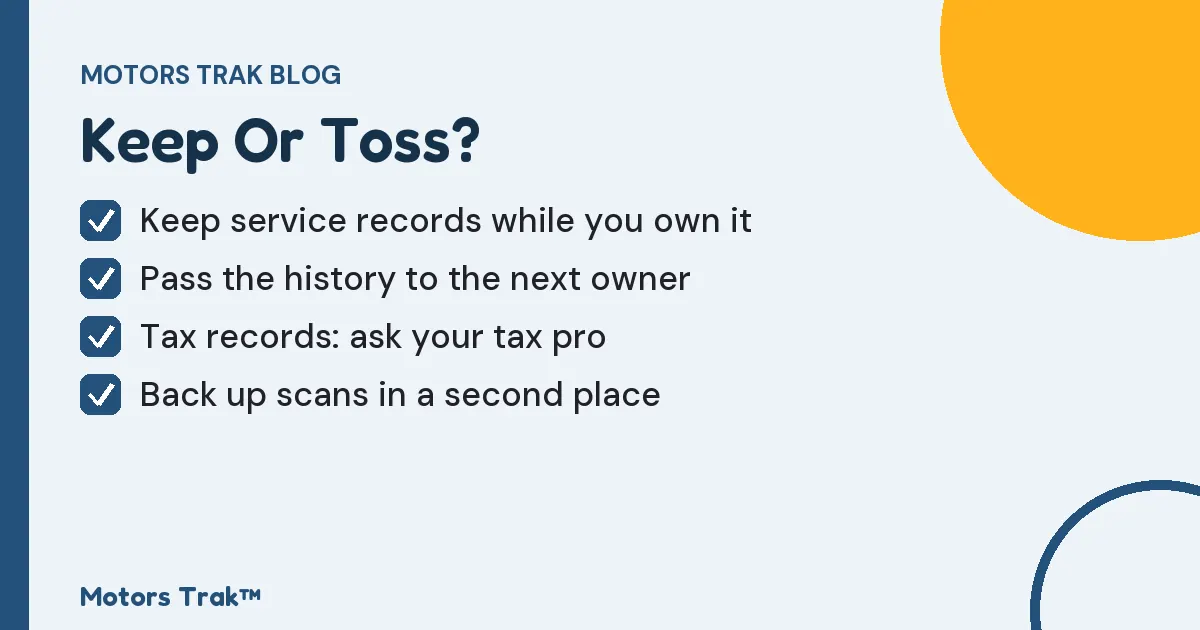
A glovebox full of faded invoices raises a fair question. Do you need every oil change receipt from 2019? Can you throw out the paperwork from the last car you sold? The answer depends on what each paper is for.
There is no single legal rule that tells car owners how long to keep maintenance records. What exists instead are a few good reasons to keep them, and each reason has its own time frame. Once you know the reasons, the answer gets simple.
The short answer
For most people, the practical rule looks like this.
- Service and repair records: keep them for as long as you own the car, then give them to the buyer.
- Warranty-related records: keep them at least until the warranty ends, and longer if a claim is open.
- Recall repair paperwork: keep it for as long as you own the car.
- Records you use for taxes: follow IRS guidance or ask a tax professional. That is a separate question from maintenance.
- Records for a car you already sold: you rarely need them, unless they support a tax return or an open dispute.
The sections below explain why.
Keep service records for as long as you own the car
The full service history is most useful in two moments. The first is when something breaks and you need to know what was already done. The second is when you sell.
A repair shop diagnosing a problem at 110,000 miles benefits from knowing the spark plugs were replaced at 98,000, or that the transmission fluid was never changed. Without the history, a mechanic may replace parts that were recently done or miss work that is overdue.
When you sell, a complete history is part of what the buyer is paying for. A stack of receipts or a printed log shows the car was cared for on schedule. We cover how buyers react to records in do service records help when you sell your car.
Because both moments can come years later, it makes sense to keep every service record from the day you buy the car to the day you hand over the keys.
Warranty records
The Federal Trade Commission advises owners to keep records of repairs and maintenance, such as oil changes and tire rotations. The FTC also explains that you do not have to use the dealer for maintenance to keep a new car warranty in effect, but you may need proof that the work was done as the manual requires.
If a warranty claim is ever questioned, your records are the evidence. At a minimum, keep everything until the warranty period ends. Many people keep them longer, since powertrain and emissions warranties can run longer than the basic coverage. Check your warranty booklet for the exact terms.
Tax records are a separate question
Some owners use a vehicle for business, or deduct certain vehicle costs. That changes what you keep and for how long, and it is a question for a tax professional.
For general background, the IRS says the usual period to keep records that support a tax return is 3 years from the date you filed, with longer periods in some situations, such as 6 years when income was underreported by more than 25 percent. The IRS also says records related to property should be kept until the period of limitations expires for the year you dispose of the property. If your car is a business asset, ask your tax advisor how that applies to you.
What you can usually throw out
Not every piece of paper earns a spot in the file.
- Duplicate copies. If you have the shop invoice, you rarely need the credit card slip too.
- Quotes for work you did not do. Keep only if you plan to compare prices again soon.
- Generic coupons and mailers. These are not records.
- Records for a car you sold years ago, once any tax or dispute questions are settled.
When in doubt, a photo takes less space than paper and is easy to keep forever.
Paper fades, so keep a copy
Thermal paper receipts, the kind many shops and parts stores print, can fade over a few years. A record you cannot read does not help anyone. Two simple habits fix this.
- Take a photo or scan of each receipt the day you get it.
- Store the copies somewhere other than the car, so a break-in or a crash does not take the records with it.
Motors Trak keeps receipts, documents, scans and photos on your phone with the service log entry they belong to. You can back the whole garage up to a file in iCloud Drive or the Files app and import it later, and you can export a service history PDF or CSV at any time. When you sell, Send Record To Buyer hands the history to the new owner. You can see these on the features list.
If you want a step by step method for building the log in the first place, start with how to keep track of car maintenance.
Do the same for every engine
The same rules apply to motorcycles, boats, mowers and generators. Boat and outboard records matter at sale time, and a log of engine hours and winterizing work is the first thing many boat buyers ask for. See how to winterize an outboard motor for what to record each fall.
Your registration card belongs in the same folder. See what happens if your registration expires for why the date matters.
Frequently asked questions
How long should I keep car maintenance records?
Keep them for as long as you own the car. They help with repairs, warranty claims and resale. When you sell, pass the history to the new owner rather than throwing it away.
Should I keep oil change receipts?
Yes, at least while the car is under warranty and ideally for as long as you own it. The FTC advises keeping records of routine maintenance like oil changes. A photo of each receipt with the date and mileage is enough for most owners.
Do I need to keep records after I sell my car?
Usually not, once you hand the history to the buyer. Keep copies only if you used the car for business or claimed vehicle costs on a tax return, and ask a tax professional how long those records should be kept.
Are digital copies of car repair receipts good enough?
For most everyday purposes, a clear photo or scan works and lasts longer than faded thermal paper. For large repairs or anything tied to a warranty claim, many owners keep the original paper as well.
Sources
- Federal Trade Commission: Auto Warranties and Auto Service Contracts
- IRS: How Long Should I Keep Records?
- NHTSA: Check for Recalls by VIN