 Motors Trak™
Change Oil By Time Or Mileage? Why Whichever Comes First Wins
You drive 4,000 miles a year. The sticker on your windshield says your next oil change is due at a mileage you will not reach until next fall. The owner's manual says something like "every 10,000 miles or 12 months." So which one counts?
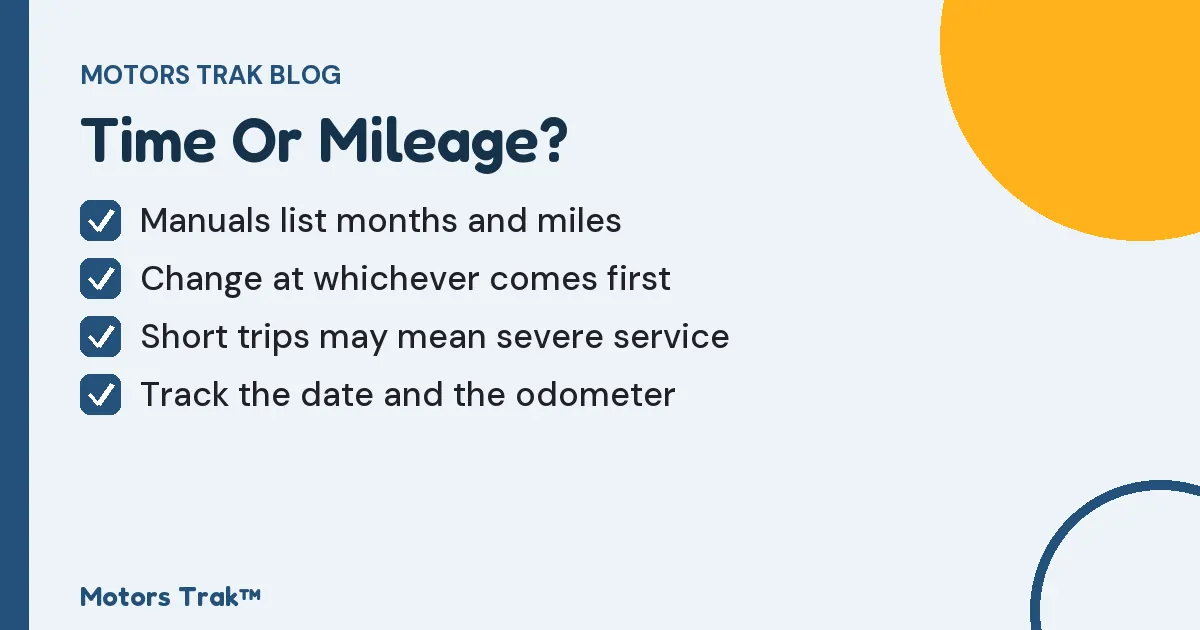
The short answer is both. Nearly every owner's manual gives an oil change interval as a mileage and a time, and you change the oil at whichever one you hit first. If you drive a lot, the miles will usually come first. If you drive a little, the calendar will.
What "whichever comes first" means
Manufacturers write maintenance intervals as a pair. A typical line reads "every 7,500 miles or 6 months, whichever comes first." The specific numbers vary a lot by make, model, engine and oil type, so the only numbers that matter for your car are the ones in your manual.
The pair exists because oil wears out in two ways.
- With use. Heat, combustion byproducts and friction break the oil down as the engine runs. Miles are a stand-in for that work.
- With time. Oil sitting in an engine still ages. Short trips that never fully warm the engine can leave moisture and fuel in the oil. Additives keep working whether the car moves or not.
This rule shows up in manuals for many kinds of engines. Honda's owner's manual for the EU2200i portable generator, for example, tells owners to perform each maintenance item "at every indicated month or operating hour interval, whichever comes first." Outboard and small engine manuals use the same idea with hours in place of miles. We explain hours in engine hours vs miles.
When time matters more than miles
Time is the limit you will hit first if any of these sound like your car.
- Low annual mileage. A weekend car, a second car or a car owned by someone who works from home.
- Seasonal use. A convertible, a classic, or a truck that only tows in summer.
- Long storage. A car parked for months while you travel or deploy.
- Short trips. Lots of drives of a few miles that end before the engine is fully warm.
Many people in this group change oil by miles only and go far past the time limit. If your manual says 12 months, a car that has gone 14 months on the same oil is overdue, even with low miles.
Normal vs severe service
Many owner's manuals list two schedules. The severe schedule has shorter intervals. AAA advises drivers to follow the time and mileage guidelines in the owner's manual, and to use the stricter schedule if their driving fits the manual's description of severe service.
Conditions manuals often list as severe include:
- Mostly short trips, especially in cold weather.
- Stop and go traffic in hot weather.
- Towing a trailer or carrying heavy loads.
- Dusty or unpaved roads.
- Long periods of idling.
Read your own manual's list. Many drivers who think they drive "normally" fit at least one of these.
What about the oil life monitor?
Many newer cars have an oil life monitor that estimates when the oil needs changing based on how the engine is used. AAA's advice is to heed it if your car has one. Most monitors still include a time limit, and some manuals give a maximum number of months even when the monitor shows oil life left. If your monitor says 40 percent but the manual's time limit has passed, follow the manual or ask your dealer.
How to track both limits
The reason people miss the time limit is simple. A windshield sticker shows one number, usually miles. The calendar side is easy to forget.
A better approach is to record every oil change with both the date and the odometer reading, then set the next reminder with both limits.
- Write down the date and mileage of your last oil change.
- Look up your interval in the owner's manual, both the miles and the months.
- Add the miles to your odometer reading and the months to the date.
- Set a reminder that fires at whichever one you reach first.
Doing this math by hand works. Remembering to check it does not, for most people. This is where an app helps. Motors Trak sets reminders by date, miles or engine hours, whichever comes first, and its Home Screen widget shows what is due next across every vehicle and machine you own. You can log the oil change itself by voice or by asking Siri to "log service." See the full feature list for details.
The same approach works for the rest of the schedule. Coolant, brake fluid and transmission service also carry time limits in many manuals, and they are even easier to forget than oil. Our guide on how to keep track of car maintenance shows how to build a full log.
A quick example
Say your manual lists oil changes at 10,000 miles or 12 months. You changed the oil on March 1 at 42,000 miles.
- If you drive 15,000 miles a year, you reach 52,000 miles around early November. Miles come first.
- If you drive 6,000 miles a year, you only reach about 48,000 miles by the next March 1. Time comes first, and the oil is due on March 1.
Same car, same manual, two different due dates. Tracking both limits gives you the right one.
Already past the limit? See what happens if you go over your oil change mileage.
Frequently asked questions
Should I change my oil by time or mileage?
Change it at whichever limit comes first. Owner's manuals usually list an oil change interval as both a mileage and a number of months. If you drive a lot, you will reach the miles first. If you drive little, you will reach the time limit first.
Is it bad to go a year without an oil change if I barely drive?
If your owner's manual lists a time limit of 12 months or less, going past it means the oil is overdue even with very few miles. Oil ages with time and short trips. Check the time limit in your manual and follow it.
Does my oil life monitor replace the time limit?
Follow the monitor, and also check your manual for a maximum time between changes. Some manuals set a time limit that applies even when the monitor still shows oil life remaining. If you are unsure, ask your dealer.
What counts as severe driving for oil changes?
Each manual defines it. Common examples include mostly short trips, stop and go driving in heat, towing, dusty roads and long idling. If your driving matches your manual's list, use the severe service schedule.
Sources
- AAA: How Often Should You Change Engine Oil
- Honda EU2200i Owner's Manual (maintenance schedule, page 46)
- Federal Trade Commission: Auto Warranties and Auto Service Contracts