 Motors Trak™
Engine Hours Vs Miles And What Hours Mean For Service
Look at a used boat listing and you will see a number like "320 hours." A riding mower has an hour meter under the seat. A generator manual schedules oil changes at "100 hours." Meanwhile your car's owner's manual talks only about miles. If you own more than one kind of engine, it helps to know what each number means and why they differ.
What engine hours measure
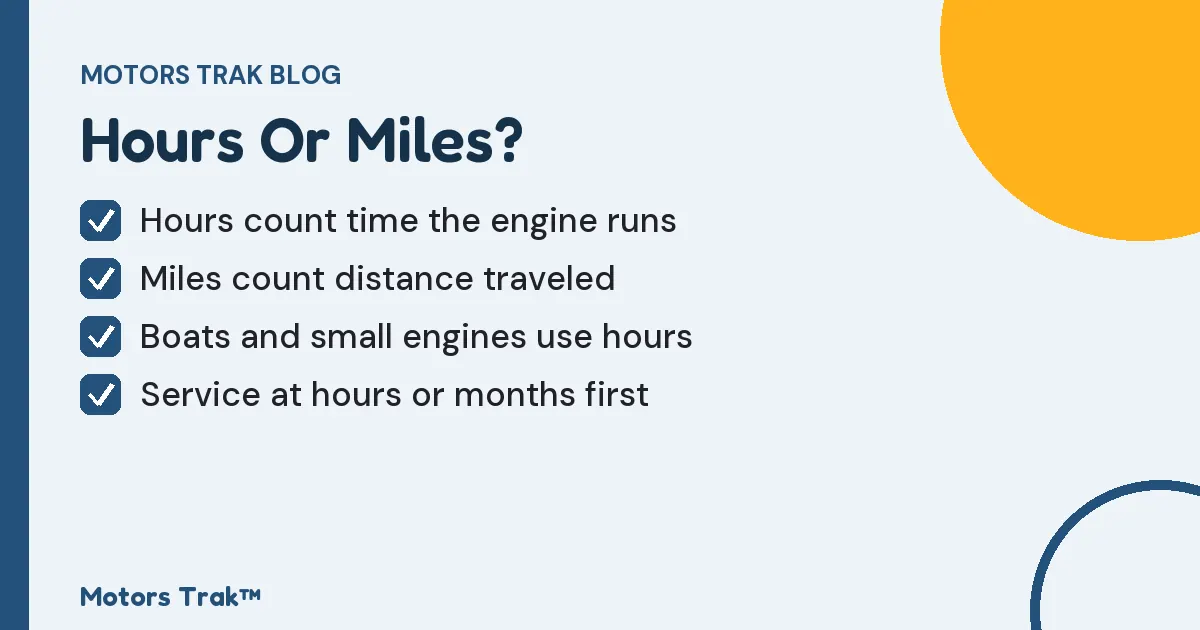
An engine hour meter counts the time the engine is running. One hour on the meter means the engine ran for one hour, whether it was idling at the dock, pushing a boat at full throttle or powering a generator through a storm.
An odometer counts distance. One mile means the vehicle moved one mile, whether that took 50 seconds on the highway or five minutes in traffic.
Both are stand-ins for the same thing, which is wear on the engine. They just measure it in different ways.
Why some engines use hours
Hours make sense for engines that do work without covering distance, or whose distance does not tell you much.
- Boats. Water does not have mile markers, and current, wind and load change how hard the engine works. Outboard makers such as Yamaha publish maintenance schedules in hours, with items at 20 hours, 100 hours and 300 hours, along with time limits.
- Generators. A generator does not move at all. Honda's EU2200i manual lists service at 20, 50, 100 and 300 hours, along with month limits.
- Lawn mowers and tractors. A mower might cover only a few miles in an hour of hard work.
- Off-road and farm equipment. Many ATVs, UTVs and tractors track hours, and some track both hours and miles.
Cars and road motorcycles use miles because the relationship between distance and engine work is steady enough for scheduling, and the odometer is already there.
Can you convert engine hours to miles?
People ask this a lot, especially when comparing a boat to a car. There is no single conversion that holds up. An hour of idling and an hour at wide open throttle put very different loads on an engine. Some rules of thumb float around online, but they assume a fixed average speed and load that may not match your use.
The better approach is to stop converting. Follow the hour schedule for engines that use hours and the mile schedule for engines that use miles. Each manual was written for its own unit.
Hours and time work together
Hour based schedules almost always pair hours with a time limit. Honda's generator manual tells owners to service "at every indicated month or operating hour interval, whichever comes first." Yamaha's outboard schedule pairs 100 hours with 1 year.
That pairing matters because many hour based machines run very little. A boat used on a few summer weekends may log 25 hours a season. If you waited for 100 hours, the oil would sit for four years. The time limit catches it first. The same logic applies to cars with low mileage, which we cover in change oil by time or mileage.
What "high hours" means on a used machine
Buyers often ask how many hours is a lot for a boat or a mower. We do not have a reliable source that gives one number for that, and it depends heavily on the engine, how it was used and how well it was maintained. A well maintained engine with more hours can be a better buy than a neglected one with fewer.
That is why records matter more than the hour reading alone. A buyer wants to see the hours at each oil change, each impeller or gear oil service and each winterizing. If you are getting a boat ready for winter, see how to winterize an outboard motor for what to record.
How to track hours if your engine has no meter
Many small engines and older boats have no hour meter. You still have options.
- Install an hour meter. Simple aftermarket meters are available for many small engines. A dealer or shop can advise on fit.
- Keep a run log. Write down when you start and stop for each use, then add it up. Even rough numbers beat none.
- Estimate by season. If you mow the same lawn every week, time a typical mow and multiply.
Tracking hours and miles in one place
The trouble with a mixed garage is that every engine speaks a different language. The car wants service every so many miles. The boat and the generator want it every so many hours. The mower might have no meter at all. A paper log for each one is hard to keep in step.
Motors Trak was built for this. Each of its 16 vehicle and machine types can be tracked in miles, kilometers or engine hours, and reminders fire by date, miles or hours, whichever comes first. Fuel use can be logged in mpg for a car or gallons per hour for a boat or generator. The Home Screen widget shows what is due next across all of them. See the features page for the full list, and the portable generator maintenance schedule for an hour based schedule in practice.
Frequently asked questions
What is an engine hour?
An engine hour is one hour of the engine running, as counted by an hour meter. It does not depend on speed or distance. Boats, generators, mowers and many off-road machines use engine hours to schedule maintenance.
How many miles is one engine hour?
There is no reliable fixed conversion. An hour of idling and an hour at full load wear an engine very differently. Follow the hour based schedule in the owner's manual for machines that use hours, and the mile schedule for those that use miles.
Why do boats use engine hours instead of miles?
Distance on water says little about how hard the engine worked, since current, wind and load vary. Running time is a steadier measure, so outboard and inboard makers write their maintenance schedules in hours, usually paired with a time limit.
Do engine hours keep counting when idling?
Yes. A standard hour meter counts time the engine is running, including idle. That is one reason hours capture wear that miles miss, such as long idling at a dock or work site.
Sources
- Honda EU2200i Owner's Manual (maintenance schedule)
- Yamaha Outboards: Winterizing And Maintenance Intervals
- BoatUS: How To Winterize Boat Engines And Drives