 Motors Trak™
How To Calculate Fuel Economy By Hand (MPG And L/100km)
Your car's dashboard may show an mpg number, but it is an estimate from the car's computer, and it can be off. If you want to know what your car really gets, or if you drive something without a trip computer, you can work it out by hand with a pen, a receipt and two fill-ups.
This guide shows the classic fill-up method for miles per gallon, how to get liters per 100 kilometers, and why your real number may not match the window sticker.
The basic formula
Fuel economy in miles per gallon is distance divided by fuel.
MPG = miles driven ÷ gallons used
The trick is measuring "gallons used" accurately. The pump tells you how much fuel went in, so the method uses two full tanks. The fuel you add at the second fill-up is the fuel you burned since the first.
Steps
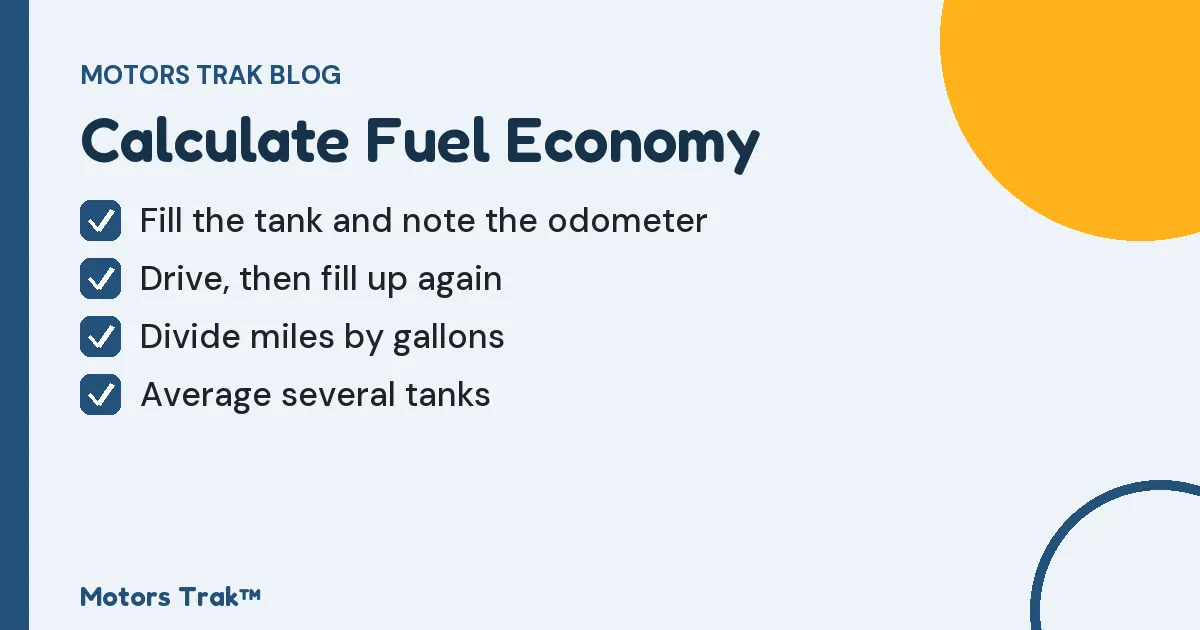
- Fill the tank completely. Fill until the pump clicks off. Use the same pump click each time so the "full" level is consistent.
- Write down the odometer reading. Or reset a trip meter to zero.
- Drive normally. Use most of the tank the way you usually drive. A longer stretch gives a more accurate number.
- Fill the tank again. Fill to the same click off point.
- Write down the gallons from the pump and the new odometer reading.
- Subtract to get miles driven. New odometer reading minus the old one.
- Divide miles by gallons. That is your mpg for that tank.
- Repeat for several tanks and average them. A single tank can be thrown off by how full the pump filled it, so an average of several tanks gives a steadier number.
A worked example
You fill up with the odometer at 23,410 miles. A week later you fill again. The odometer reads 23,742 and the pump shows 11.2 gallons.
- Miles driven: 23,742 minus 23,410 = 332 miles
- MPG: 332 ÷ 11.2 = about 29.6 mpg
If the next two tanks come out at 28.1 and 30.4 mpg, your average across three tanks is about 29.4 mpg.
Calculating L/100km
Most of the world measures fuel economy the other way around, as liters used per 100 kilometers. Lower is better.
L/100km = (liters used × 100) ÷ kilometers driven
Example: you drove 540 km and the pump shows 38.5 liters.
- 38.5 × 100 = 3,850
- 3,850 ÷ 540 = about 7.1 L/100km
To convert US mpg to L/100km, divide 235.215 by the mpg figure. So 29.6 mpg is about 7.9 L/100km. The same formula works in reverse: 235.215 divided by L/100km gives US mpg.
Some countries also use kilometers per liter. That is simply kilometers driven divided by liters used.
Electric vehicles and engines that measure hours
The same idea applies to other machines, with different units.
- Electric vehicles use miles per kilowatt hour, or mi/kWh. Divide miles driven by the kilowatt hours used to charge.
- Boats, generators and other hour based engines often use gallons per hour. Divide the gallons you added by the engine hours run since the last fill. We explain hours in engine hours vs miles.
Why your number differs from the sticker
The EPA rating on a new car's window sticker comes from standardized lab tests. Real driving is different, and FuelEconomy.gov, the US government fuel economy site, describes several things that lower real world mileage.
- Aggressive driving. FuelEconomy.gov says speeding, rapid acceleration and hard braking waste gas.
- Highway speed. The site notes that gas mileage usually drops quickly above 50 mph.
- Short trips and cold weather. Cold weather hurts mileage most on short trips, according to the site's cold weather page.
- Idling. As the site puts it, idling gets 0 miles per gallon.
- Tire pressure. Underinflated tires lower gas mileage. Use the pressure on the door jamb sticker or in the manual.
When fuel economy drops, look for a reason
A sudden drop in your hand calculated mpg, with no change in how or where you drive, can be an early sign that something needs attention. It may be as simple as a change in season or tire pressure. If it persists, mention it to your mechanic along with your fill-up history.
That is the real value of tracking fuel economy over time. One tank tells you little. Twenty tanks show a trend.
Let the log do the math
Doing the math on a receipt works, but keeping it going for months is where most people stop. Motors Trak has a fuel log that calculates mpg, mi/kWh or gal/hr from each fill-up, and you can log fuel by asking Siri to "log fuel" or by voice. Each fill-up sits in the same garage as the service log for that vehicle, so you can see a mileage change next to the work that was done. See the features page for more, and our guide on how to keep track of car maintenance for building the rest of the log.
Frequently asked questions
How do I calculate my car's mpg?
Fill the tank and note the odometer. Drive until you need fuel, fill up again, and note the gallons and the new odometer reading. Subtract the two readings to get miles driven and divide by the gallons. Average several tanks for a better number.
Is the mpg on my dashboard accurate?
It is an estimate from the car's computer and can differ from what you calculate by hand. The fill-up method over several tanks gives you a check on the dashboard number.
How do I convert mpg to L/100km?
Divide 235.215 by your US mpg figure. For example, 30 mpg is about 7.8 L/100km. To go the other way, divide 235.215 by the L/100km figure.
Why is my real mpg lower than the EPA rating?
EPA ratings come from standardized tests. Real driving adds factors like high speed, aggressive acceleration and braking, short trips in cold weather, idling and low tire pressure. FuelEconomy.gov describes each of these as a cause of lower real world mileage.
Sources
- FuelEconomy.gov: Driving More Efficiently
- FuelEconomy.gov: Keeping Your Car In Shape
- FuelEconomy.gov: Fuel Economy In Cold Weather